APLA Book Prize in Critical Anthropology recognizes work that best exemplifies creativity and rigor in the ethnographic exploration of politics, law, and/or their interstices.
ANNOUNCING THE 2024 WINNER AND THE HONORABLE MENTION:
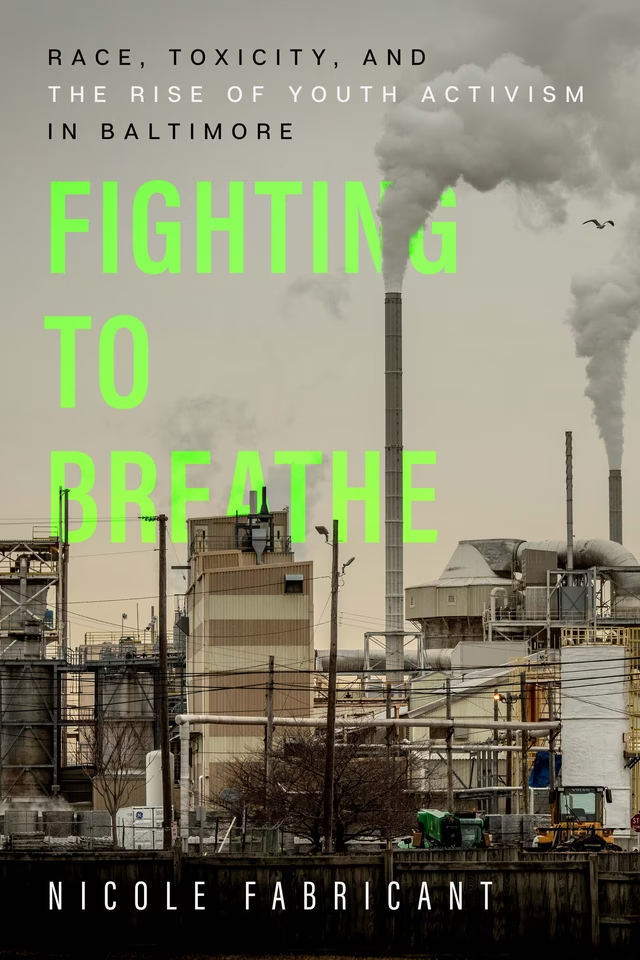
Congratulations to Nicole Fabricant for Fighting to Breathe: Race, Toxicity and the Rise of Youth Activism in South Baltimore (UC Press, 2022).
Fighting to Breathe is an extraordinary ethnography of student activism in a Baltimore high school and primer both on how to organize community groups and how to conduct engaged ethnographic research. Based in a context of historical environmental racism, the book invites readers to notice, reimagine, and take seriously breathing as a risk and a resource in the context of racial violence, urban inequality, and toxic ecologies. What makes it stick out from the rest of the amazing books we read is the way that it develops its theorizations from the work and words of young activists. Beginning with a compelling cast of characters, the book constructs its analysis from the bottom up, avoiding political and theoretical generalizations, by following specific actors through three complex local struggles, with varying degrees of success. Fabricant deals head-on with the difficulties of organizing and the contradictions of doing ethnography in these spaces, producing what is ultimately an optimistic, hopeful, and accessible work that is less about injustice than it is about repairing the world.

Congratulations also to Sahana Ghosh for A Thousand Tiny Cuts: Mobility and Security across the Bangladesh-India Borderlands (UC Press, 2024) that earned the honorable mention.

A Thousand Tiny Cuts is a composite portrait of the complex relations forged in the borderlands between India and Bangladesh. Moving quickly past the spectacular violence that created and continues to maintain the border, A Thousand Tiny Cuts explores the quotidian encounters of people whose lives are shaped by the border but who also find ways to exist alongside it [, to participate in the minutiae of what she calls “bordering.”] [Ghosh presents us with a model of feminist “mobile ethnography,” which sees her reflecting deeply on how her own position shapes her own movement and research through the borderlands.] Throughout, the book not only sparkles with surprising insights about gender, kinship and value, but does so through deeply moving portraits of ordinary lives navigating cross-border marriage, movement, and various forms of trade. [In all of these stories the border (and the nations that it separates) is never only one thing, but a series of material intrusions into specific networks of relations. This is ethnographic complexity at its best, a deeply probing exploration that is held together by clear methodological intentions.
A huge thanks also goes to the APLA Critical Ethnography Book Prize Jurors: Kregg Hetherington (chair), Sophie Chao, Irina Silber, and Robert Samet.
APLA Student Paper Prize recognizes graduate student work that expands the purview of political and legal anthropology and challenges us to think in new ways about power, politics, and law.
ANNOUNCING THE 2024 WINNER AND THE HONORABLE MENTION:
Congratulations to Ziya Kaya (University of Arizona) whose paper “‘Terrorist’ Red Spiders: Securitization of Farms and Farmers on Turkey’s Digital Frontiers” is the winner of the 2024 Student Paper Prize! As members of the committee write, Kaya’s paper marries textured ethnographic material with critical scholarship on agriculture, security, governance, and multispecies entanglements to produce a fascinating piece on farmers implicated in the cultivation of both crops and national security. It models the best kind of anthropology.
Congratulations also to Aaron Su of Princeton University who was awarded an honorable mention for his paper “The (Im)possibility of Indigenous Politics: Collaborative Medical Design and the Limits of Settler Democracy in Taiwan.”
A huge thanks to the APLA Student Paper Prize Jurors: Mark Schuller (chair), Bilge Firat, and Anna Offit!

 Association for Political and Legal Anthropology