At the 2025 AAA Meetings in New Orleans, APLA demonstrated its vitality as a section committed to both critical scholarship and public-facing interventions. APLA hosted an unprecedented number of sessions and a lively slate of special events focused on mentorship and community engagement. If you were not able to join us in NOLA, here is a recap below!
Thanks to Susan Bibler Coutin for contributing to this recap and to SJ Dillon for photos.
For their incredible work on this year’s program, THANK YOU to: APLA incoming president Elif Babül, incoming president elect Nicole Fabricant, the 2025 events committee (Elif, Anand Vaidya, Dilan Yildirim, Ana Marrugo, and SJ Dillon), and APLA’s 2025 program committee (Anand Vaidya and Meghan Morris).
APLA’s AAA Program
This update comes from the program committee’s annual report.
APLA hosted an impressive ninety-six sessions at this year’s AAA. 3 conversations/debates, 28 flash presentations, 47 oral presentation sessions, 6 posters, and 19 roundtables. Numerous sessions addressed right-wing politics, authoritarianism, and fascism, both in the United States and in other regions; as well as carcerality, policing,and migration. There were relatively few sessions that fit squarely within the bounds of legal anthropology.
Two panels directly addressed APLA’s own activities. One, “Responding to Urgent Threats to Democracy, especially Universities: Learning from Haiti,” was structured as a conversation responding to Darlène Dubuisson’s book Reclaiming Haiti’s Futures: Returned Intellectuals, Placemaking, and Radical Imagination in order to discuss APLA’s Taskforce on Academic Freedom. A second, “Looking Ahead with PoLAR: A Roundtable on the Future of Legal and Political Anthropology,” discussed the future of both the journal PoLAR and the broader field of legal and political anthropology.
APLA also hosted three invited sessions: “Critique the World/Save the World: Ghosts of a Global Order in the Present,” “Embodied Archives: Bones, Memories and the Afterlives of Enslavement and Genocide,” and “On the Ruins of Liberalism: Ethnographies of Far-Right Regime Building, Part 1.”
Finally, APLA also held a late-breaking session organized by APLA board members-at-large, Hayal Akarsu and Simanti Dasgupta: “De-exceptionalizing US Universities: DEI and Narratives from the Margins.”
Speaking Justice to Power 2025: “Academic Freedom, Immigration, and Carceral Regimes”
Co sponsored by APLA and ASAP (Association for the Anthropology of Policy)
Overview by Susan Coutin
On a warm Saturday evening (November 21, 2025), approximately 150 people gathered in the beautiful Ashé Cultural Arts Center in New Orleans for a presentation by Matt Olson of the New Orleans Workers’ Center for Racial Justice and Mary Yanik, Co-director of the Immigrant Rights Clinic at Tulane University.
The event was timely, as ominous news stories about an upcoming immigration enforcement deployment in New Orleans were circulating, putting many on edge. The speakers described unionization and the immigrant rights movement in New Orleans, highlighting the intersections between these two issues. For example, they noted, following the devastation that Hurricane Katrina wrought on New Orleans and the surrounding area, immigrant workers were brought into the city to remove toxic debris and to rebuild. Solidarity across lines of race and legal status has grown, as criminalization and immigration enforcement have impacted communities of color. As a result, the local movement avoids narratives that distinguish between “good’ and “bad” immigrants, instead stressing commonality, humanity, and the nuance of individual situations.
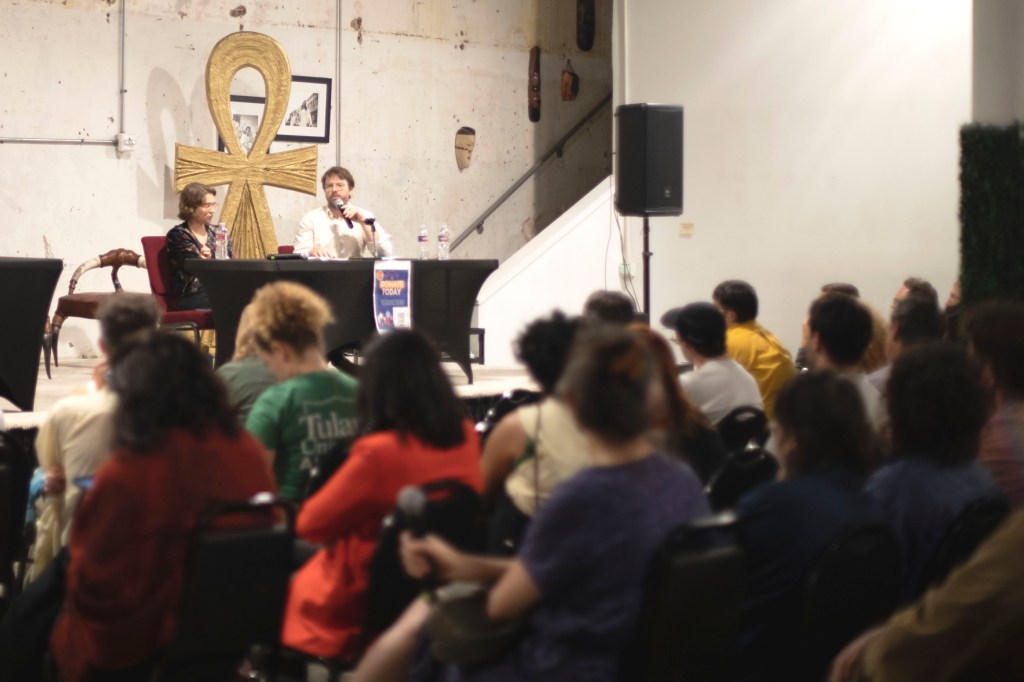
Photo by SJ Dillon
In response to an audience question about how academics and the university can support workers and immigrants, the speakers suggested the following: talk to students, share information, bring in community speakers, do research on country conditions, and serve as an expert witness in an immigration case. The speakers encouraged audience members to remember that colleges and universities are sites of struggle and also that campuses are not the only place where these struggles take place. Lastly, speakers noted the mental health effects of these enforcement efforts.
Afterward, attendees gathered to eat a delicious meal catered by Chef Dez of The Taylor’d Chef, catch up with each other, and view the powerful exhibits on display. The event exemplified APLA and ASAP’s hallmark values of relevance, practical knowledge, and community building.
To support the New Orleans Workers’ Center for Racial Justice, click here.
To support Tulane’s Immigrant Rights Clinic, click here.
APLA Letter Writing Campaign to Local Detained Community Members
Special thank you to Martha Alguera of the Southeast Dignity Not Detention Coalition for her help organizing this!
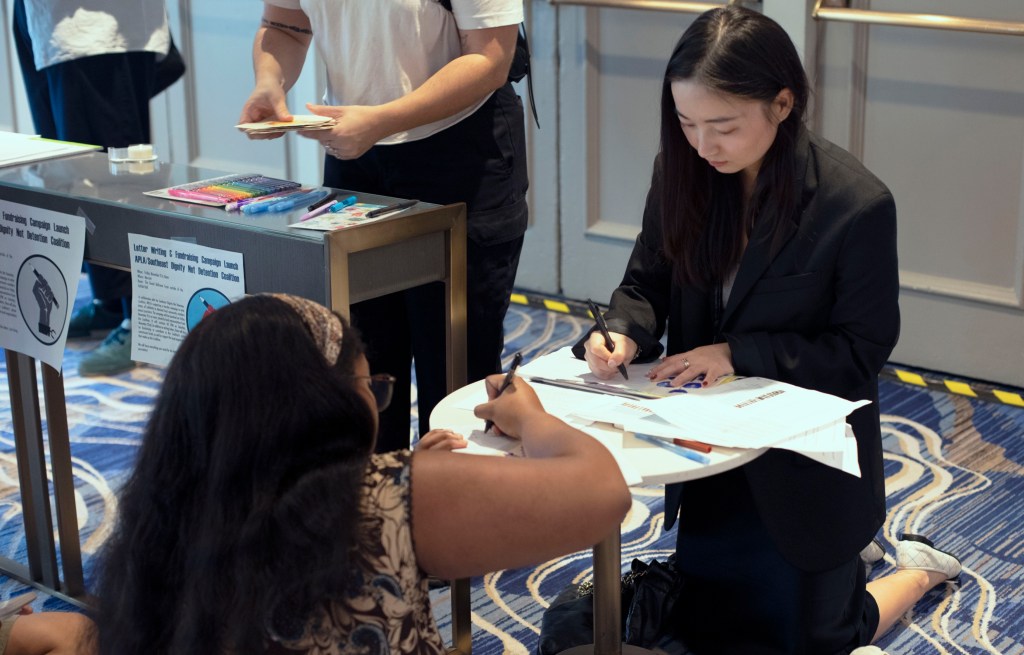
APLA organized a multi-day letter writing campaign in collaboration with the Southeast Dignity Not Detention Coalition. Participants wrote messages to be sent to detained local community members in various local detention centers. The names of community members and the detention centers were provided by the Southeast Dignity Not Detention Coalition, who also sent the letters to addressees.
The campaign was powerful and provided a different register for engagement in local issues alongside the intellectual space of the conference. Writing these letters, alongside others, also produced a sense of collective solidarity with those in detention. The event had an added poignance and urgency owing to the palpable threats of an Ice-raid in downtown New Orleans during the conference.
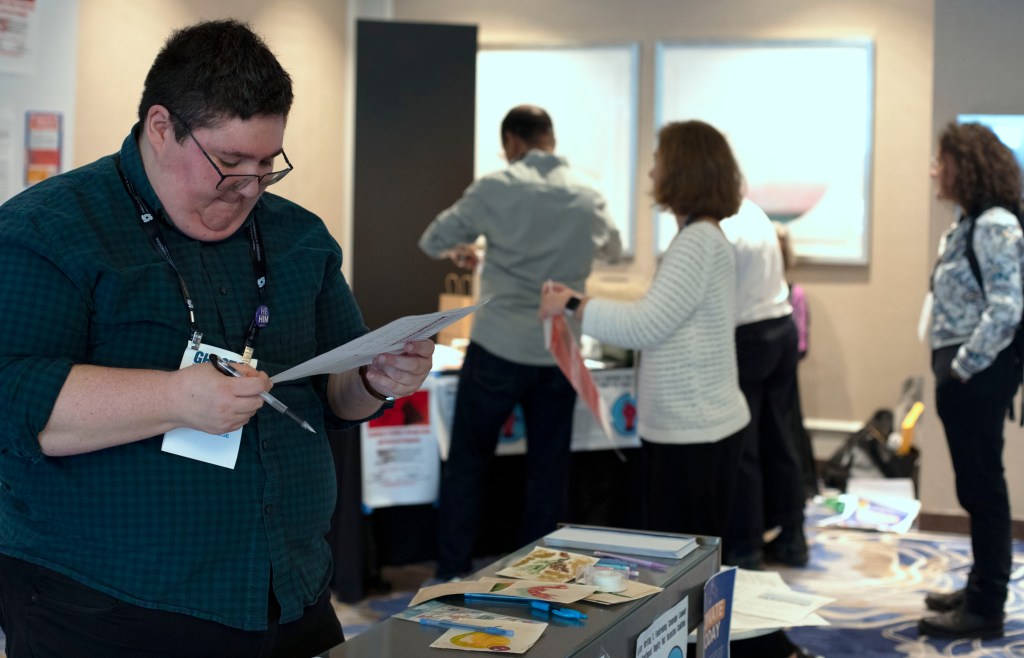


Photos by SJ Dillon
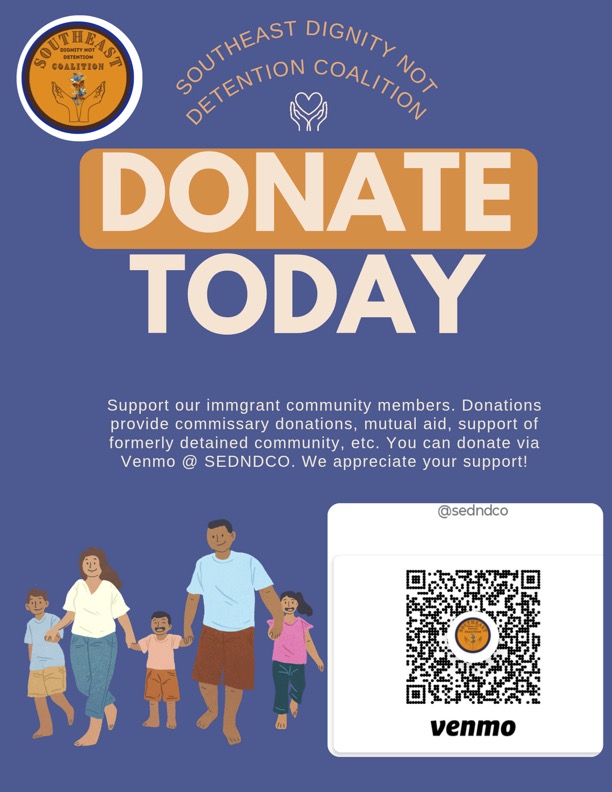
Please consider donating to the Southeast Dignity Not Detention Coalition. Information below.
APLA 2025 Speed Mentoring Event
Organized by APLA Graduate Student Representatives, Ana Marrugo and SJ Dillon
Saturday, November 21
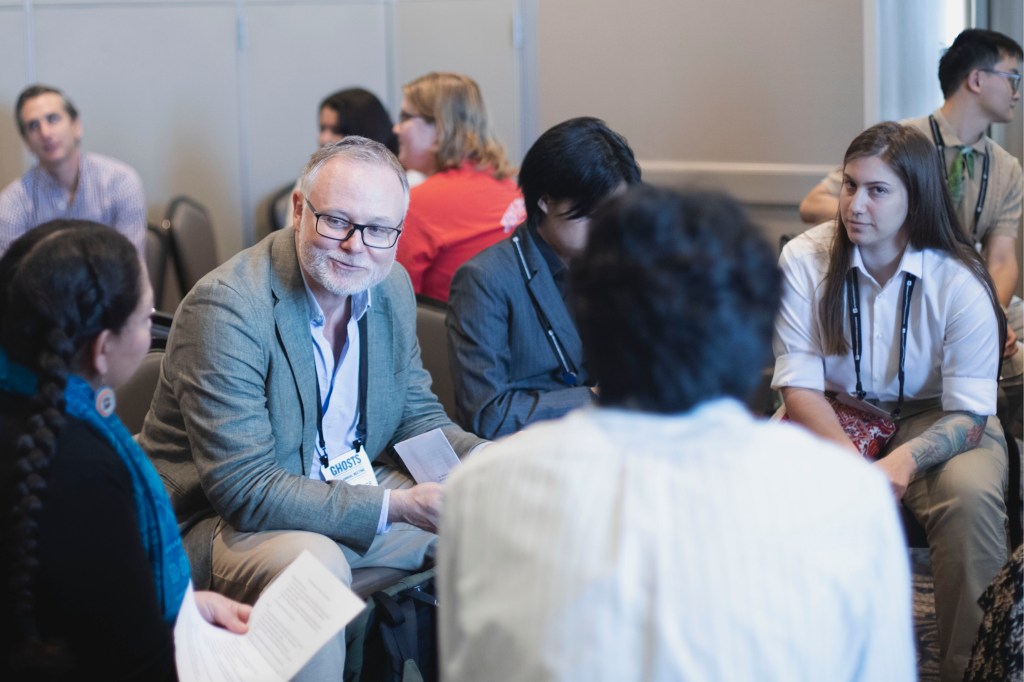
The event brought together mentees planning their graduate or post-graduate career steps, in and outside of academia, with experienced researchers and established faculty members.
Photos by SJ Dillon
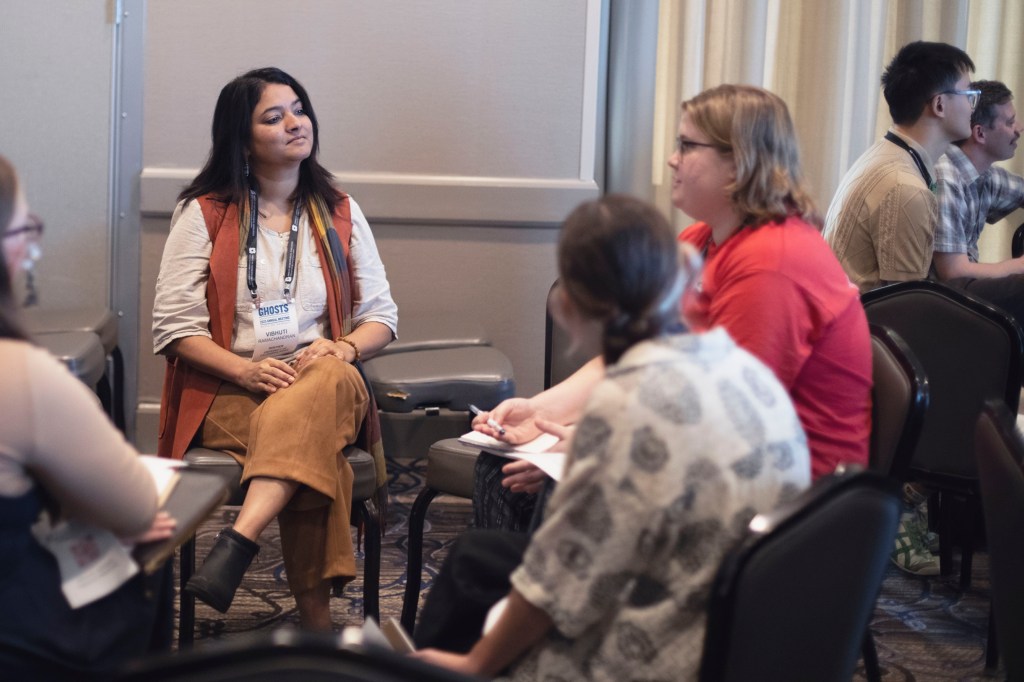
There was a large turnout of both mentees and mentors, and the environment was engaged, convivial and supportive. Graduate student representatives organized mentorship groups in small circles focused on particular topics/themes and encouraged students to move between these groups in scheduled shifts after engaging with each theme and small group. This allowed students meet the maximum number of mentors at the event, encouraged students to ask personalized questions relating to their own needs, and increased the number of people actively speaking with mentors.

APLA 2025 Business Meeting
Recap by Susan Bibler Coutin
The Business Meeting of the Association for Political and Legal Anthropology (APLA) took place on November 20, 2025. APLA members filled a conference room at the Marriott in New Orleans. APLA President Heath Cabot was unable to travel owing to a recent medical event, so she ran the meeting via Zoom. She began by thanking APLA officers and board members, especially those whose terms were concluding, and by welcoming new officers and members to APLA. She acknowledged and thanked APLA program chair Anand Vaidya and Meghan Morries, who produced an excellent academic program for the New Orleans AAA meeting. Meghan will become program chair next year, and will be joined on the committee by Deniz Yunucu.
The APLA events committee was chaired by incoming APLA president Elif Babül, with Anand Vaidya, Dilan Yildirim, Ana Marrugo, and SJ Dillon. The events committee organized online events on the 2024 election and the criminalization of immigrants, as well as public-facing events for the AAA meeting, including this year’s Speaking Justice to Power event. Jennifer Curtis, PoLAR associate editor, edits numerous blog series for PoLAR, manages PoLAR Online, and runs the APLA Digital Editorial Fellows Program. Ana and SJ Dillon have served as graduate representatives and helped to put together a speed mentoring event for this year’s AAA meeting. Heath Cabot also thanked the following officers who are stepping down this year: Simanti Dasgupta (board member at large), Bilge Firat (board member at large), March Schuller (secretary), Taras Fedirko (Anthropology News column editor), and Whitney Russell (Anthropology News column editor).
The meeting continued with Heath Cabot extending a warm welcome to the new APLA officers: Jessica Olivares (Anthropology News column editor), Cagri Yoltar (Anthropology News column editor), Ayşe Parla (board member), Jeffrey Kahn (board member), Chika Watanabe (board member), Leo Coleman (secretary), Nicole Fabricant (president-elect), and Elif Babul (president). Heath also thanked APLA officers who are continuing: Deepa Das Acevedo (PoLAR editor-in-chief), Will Garriott (treasurer), and members at large Hayal Akarsu, Sahana Ghosh, and Anna Offit. There are future openings for APLA members who would like to organize events or serve as APLA webmaster. And of course, APLA members acknowledge the incredible work of Heath Cabot who is stepping down as president.
After these words of appreciation, APLA prizes were awarded! Mark Schuller thanked the graduate student paper prize committee (Mark Schuller, Taras Fedirko and Hayal Akarsu) and announced the winner Johnathan Norris of Boston University for the paper“Queering Safety in a State of Penetration: Intermittent State Violence and a Politics of (In)Visibility.” Honorable mentions were also given to Hayat-Alessandra Bahit’s “This Sea Was Mine: The Sea as a Space of Loss and Imagination in Palestinian Narratives” and Thomas Long’s “‘MAGA is the Message:’ Retheorizing the (In)Coherence of Pro Trump Politics Through McLuhan.”
Sahana Ghosh thanked the book prize committee (Sahana Ghosh, Mahmoud Keshavarz, Narges Bajoghli, and Katherine Lemons) and awarded the APLA Book Prize in Critical Ethnography to Sandhya Fuchs, University of Bristol, for Fragile Hope: Seeking Justice for Hate Crimes in India (2024, Stanford University Press).
The next item of business was a report by PoLAR editor Deepa Das Acevedo regarding the publishing options that are available to APLA at the conclusion of the Wiley Blackwell contract. The AAA has recently made the difficult decision to cut the number of AAA journals to make its journal portfolio more attractive to potential publishers. There are two options through the AAA: 1) dissolve PoLAR and join Anthropological Praxis, a new journal being developed by the AAA, or 2) dissolve PoLAR and create a new journal with other sections. Both of these options would result in the termination of PoLAR as a stand-alone journal. It is unclear what APLA’s word count would be in these two options. There would be no cost to APLA going forward, nor would there be revenue.
APLA leadership has identified a third option: 3) publish PoLAR with a university press. In this option, there is a possible contract with Cambridge under consideration. APLA leadership is excitedly pursuing this option with the goals of maintaining PoLAR as an independent venue for scholarship in political and legal anthropology, protecting APLA through this time of uncertainty, and developing a long-term operational model. The Cambridge contract would include open access and support for managing editorial work and copyediting.
The remainder of the business meeting was devoted to discussing these options. APLA membership in attendance appeared quite excited about option 3, as well as grateful to the APLA leadership for creating this opportunity.

 Association for Political and Legal Anthropology