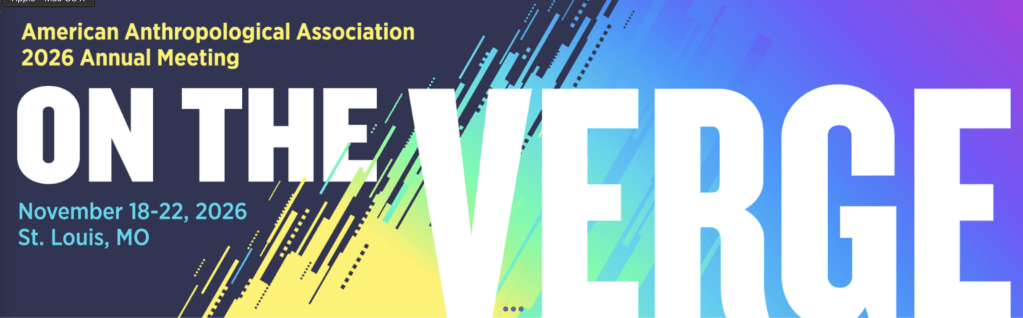
On the Verge is the theme for the 2020 AAA Annual Meeting, which will be held November 18 – November 22 in St. Louis, Missouri.
Abstract and panel proposal due dates submissions are officially closed on the AAA website as of May 6, 2026— and via our website and listserv, APLA wants to help members connect with other scholars seeking to develop or complete a panel. As the AAA portal is now closed, we are no longer accepting abstracts for this year. Please check back to our website next year for the updated collaboration hub!
At that time, you can send your panel abstract to our Communications Liaison and Website Manager, SJ Dillon. Your panel and abstract would then be posted below and shared on the APLA mailing list.
Below is our CFP links for the 2026 year. Feel free to check out 2026 APLA abstracts below:
Houses on the verge: mediating uncertainty and becoming through domestic worlds
What happens when houses are no longer sites of stability, but dynamic spaces where uncertainty lingers and life unfolds through processes of becoming? How do material environments become a site for mediation where uncertainties are experienced and negotiated? Houses are dynamic spaces where memories and anticipations intersect (Carsten, 1997; Carsten & Hugh-Jones, 1995; Janowski, 2007). In the contemporary world, domestic spaces are increasingly shaped by disaster (Mazumdar et al., 2021), military occupation (Segal, 2016; Zia, 2019), geopolitics (Smith, 2020), migration (Friedman and Mahdavi, 2015) and urbanization (Beier et al., 2021) challenging their conventional association with safety and permanence. Rather than being stable containers of social life, houses can come to constitute lived experience on the verge. This panel approaches domestic space as a threshold, reimagined, and reconfigured in terms of materiality, temporality, and relatedness.
We are particularly interested in how domestic spaces are reshaped through conditions such as migration, cross-border mobilities, disappearances, climate-related disruptions, and shifting regimes of governance. Rather than treating instability as exceptional, we invite contributions that explore how uncertainty becomes embedded in and negotiated through everyday living. How do practices of waiting, searching or anticipating constitute forms of dwelling? How might attention to these domestic worlds in flux reframe broader anthropological understandings of kinship, temporality and environment?
We welcome papers across regions and subfields that attend to the shifting, uncertain, and generative qualities of domestic life, and those that engage with, but are not limited to the following themes:
- Housing and environmental disruptions (e.g., flooding, earthquakes, slow onset disasters, climate change)
- Migration, displacement, and transnational mobilities
- Conflicts and shifting regimes of governance
- Appearances, disappearances, spatiality and belonging
- Housing, infrastructure and urbanization
- Temporalities of dwelling: cycles, anticipation, and waiting
If you are interested in participating as a panelist, discussant, or chair, we would be delighted to hear from you. Please contact Ranjita Dilraj and Yaxuan Su at ranjitadilraj@u.nus.edu and yaxuan.su@u.nus.edu by Wednesday, April 15. For those interested in presenting, please also include an abstract (up to 300 words) and a short bio.
References:
Beier, R., Spire, A. and Bridonneau, M. (Eds.). (2021). Urban resettlements in the Global South: Lived experiences of housing and infrastructure between displacement and relocation. Routledge.
Carsten, J. (1997). The heat of the hearth: The process of kinship in a Malay fishing community. Oxford University Press.
Carsten, J., & Hugh-Jones, S. (Eds.). 1995. About the house: Lévi-Strauss and beyond. Cambridge University Press.
Friedman, S. L., & Mahdavi, P. (2015). Migrant encounters: Intimate labor, the state, and mobility across Asia. University of Pennsylvania Press.
Janowski, M. (2007). Being ‘big’, being ‘good’: feeding, kinship, potency and status among the Kelabit of Sarawak.
Mazumdar, S., Itoh, S., & Iwasa, A. (2021). Post-disaster temporary housing: An emic study of lived experiences of victims of the great East Japan earthquake and tsunami. International Journal of Mass Emergencies & Disasters, 39(1), 87-119.
Segal, L. B. (2016). No Place for Grief: Martyrs, Prisoners, and Mourning in Contemporary Palestine. In No Place for Grief. University of Pennsylvania Press.
Smith, S. (2020). Intimate geopolitics: Love, territory, and the future on India’s Northern threshold. Rutgers University Press.
Zia, A. (2019). Resisting disappearance: Military occupation and women’s activism in Kashmir. University of Washington Press.
Deserving Bodies, Contested Injuries: Moral Economies of Worker Health
Organizers: Zeynel Gül (University of Illinois, Chicago) and Gabriela Morales (Scripps College)
Discussant: Alex Nading (Cornell University)
This panel centers the moral economies that emerge around sickness, injury, and toxic exposure stemming from work and the workplace. We seek papers that unpack how workers, medical providers, legal experts, occupational safety experts, and employers evaluate bodily harm—and its prevention and compensation—in the workplace. What kinds of work and what kinds of harm do these actors render visible or invisible? Given that occupational health is a highly state-centered concept, what notions of fairness, value, and acceptable risk do people with occupational injuries mobilize within and beyond regulatory discourses?
Occupational health offers a unique vantage point for observing how the “worthiness” of lives is differentially distributed. Further, the slow violence of chronic disease and disability due to work extends biopolitics beyond the simple binaries of living or dying (Livingston 2005; Puar 2017). Yet, like other biomedical fields (Street 2014), occupational health is also less stable and unified than it might first appear; it requires continual coordination and stabilization of what constitutes work, the workplace, and workplace harm. The multiplicity of actors involved in such coordination puts pressure on perspectives that view the moral economy as a monolithic concept emerging solely as a response to aggressive market economies (see also Fassin 2015 on this point). We ask: what intermediary components—such as health systems, families, courts, and bureaucracies—are engaged in the production and circulation of morals and values around the injured worker’s body? How do the dynamic interactions between these components generate new categories, identities, and values while simultaneously dispersing the knowledge and visibility of harm? Even further, for workers and providers alike, institutional assessments and compensation for harm can be unsatisfactory—and lead to alternative ways of relating to injury and exposure. How, we ask, might we also reimagine what constitutes health in relation to work (or work in relation to health), within and beyond capitalist systems?
Please send a title and an abstract for your paper (of no more than 300 words) to gmorales@scrippscollege.edu and zgul2@uic.edu by April 15, 2026.
Theorizing War: What Is Anthropology Good For?
Organizers: Dafna Rachok (UNC Chapel Hill) and Jessica Storey-Nagy (Indiana University)
Anthropology has long had an uneasy relationship with war. Although the discipline emerged in the context of imperial conquests and was later shaped by the Cold War production of knowledge (Gusterson 2007), anthropologists continue to argue that modern war and militarism remain somewhat underexplored within the discipline. Moreover, with few exceptions (Lutz 2001; Nordstrom 2004; Dunn and Bobick 2014; Masco 2014; Dewachi 2015), anthropology has also ceded the theorization of contemporary warfare and global order to political science and international relations, even while criticizing other disciplines’ simplifications, cultural reifications, and geopolitical blind spots.
This panel asks what anthropology is good for at a moment when war once again structures everyday life, public discourse, and political imagination across multiple regions. What is anthropology good for in the moment when the majority of global populations seem to constantly live on the verge of and during war? This panel approaches war not only as an event of rupture, escalation, or invasion, but also as a condition of living on the verge: on the verge of violence, displacement, illness, moral injury, political transformation, and epistemic collapse. The panel explores how anthropology can illuminate the everyday, discursive, symbolic, and structural dimensions of war that are often obscured by policy, media, and military analysis.
The panel highlights ethnographic and interpretive approaches to war’s lived textures and lingering afterlives. The panel argues that anthropology’s distinctive contribution lies in producing an affect of transnational empathy and understanding by clarifying war’s ambiguities, tracing its uneven effects, and theorizing life lived on the verge of catastrophe.
If you are interested in participating as a panelist, discussant, or chair, we would be delighted to hear from you. Please contact Dafna Rachok at rachok@unc.edu by Friday, April 17. For those interested in presenting, please also include an abstract (up to 300 words) and a short bio.
References:
Dewachi, Omar. 2015. “Blurred Lines: Warfare and Health Care.” Medicine Anthropology Theory 2(2). https://doi.org/10.17157/mat.2.2.185.
Dunn, Elizabeth Cullen, and Michael S. Bobick. 2014. “The Empire Strikes Back: War without War and Occupation without Occupation in the Russian Sphere of Influence.” American Ethnologist 41 (3): 405–13.
Gusterson, Hugh. 2007. “Anthropology and Militarism.” Annual Review of Anthropology 36:1.
Lutz, Catherine. 2001. Homefront: A Military City and the American Twentieth Century. Beacon Press.
Masco, Joseph. 2014. The Theater of Operations: National Security Affect from the Cold War to the War on Terror. Duke University Press.
Nordstrom, Carolyn. 2004. Shadows of War: Violence, Power, and International Profiteering in the Twenty-First Century. University of California Press.
Legislative Anthropology: A Roundtable Reflection
Organizers: SJ Dillon (Emory University) and Neil Kaplan-Kelly (Flagler College)
Anthropological studies of politics and the law have long focused on the space of the bureaucracy and policy-producing wings of states and judicial fields. Legal anthropology has historically been centered on the courts, whereas political anthropology has long concentrated on what could be called the executive branch broadly. Those studies around states and state action are important but often overlooked is ethnographic engagements with the space of the legislature. As Neil Kaplan-Kelly put it: “Law is all around me, but the legislative process is not the direct subject of these ubiquitous discourses.”
This roundtable centers on the anthropology of legislatures and seeks to encourage more such analyses. We ask: why have legislatures been so overwritten in anthropological work in the past? What do engagements with the legislature tell us about the law, democratic processing, and politics? Does engaging with the legislature break down the separation between legal and political anthropology and the idea of separate branches of state engagement? How do legislatures frame legal consciousness and produce legal zones and illegal embodiments? How are the rituals of legislatures critical to their functioning, and what does this mean for the law as a kind of binding performance or representation? What are the objects and subjects of legislative debate and governance? What kinds of messages do legislatures communicate to the population they seek to discipline, and what kinds of messages do citizens communicate to the legislators they seek to influence? How are legislatures impacted by surrounding discourses, and what does this mean for democracy as a theoretically reflective practice? How are legislatures sites of political relationship-building and interpersonal connection? What kinds of methods and practices should or could anthropologists use in researching legislatures, and what do these methods and research findings offer legal and political anthropology as wider fields?
If you are interested in participating as a panelist, discussant, or chair, we would be delighted to hear from you. Please contact SJ Dillon at sjdillo@emory.edu and Neil Kaplan-Kelly at NKaplanKelly@flagler.edu.
Reference:
Kaplan-Kelly, Neil. 2021. “Introduction: Reflective Conversation: Revisiting and Revitalizing Ethnographies of Legislatures.” PoLAR: Political and Legal Anthropology Review Emergent Conversations. https://polarjournal.org/2021/11/18/introduction-reflective-conversation-revisiting-and-revitalizing-ethnographies-of-legislatures/
AAA 2026 Call for Papers: Ecologies of Repair
Darcey Evans, Assistant Professor, Department of Anthropology, Stony Brook University Lindsay Ofrias- Research Associate, Mahindra Humanities Center, Harvard University
This panel considers how approaches to ecological repair and renewal are reshaping meanings of and pursuits for justice across legal, medical, and more-than-human domains. While environmental justice movements have long centered legal accountability and compensation, a growing body of work in Indigenous studies, Black studies, and environmental anthropology has turned attention to multispecies attunement, ecological reparations, and relational repair as alternative or complementary frameworks. In this panel, we explore how repair emerges as an ongoing, situated process that reconfigures relationships between humans, more-than-humans, infrastructures, and institutions. In conversation with scholars who call for reparations, this panel approaches repair not as a return to an imagined past or an undoing of harm, but a way to think through hope, healing, and futurity alongside the forms of violence that generate the need for repair in the first place.
We invite contributions that explore both the generative potential and the limits of existing frameworks of repair and renewal, guided by but not limited to the following questions: How do communities advance reparative processes in contexts of ecological harm and political violence? How do different forms of knowledge shape what counts as harm, repair, and responsibility, and who determines when repair is sufficient? What remains irreparable, and who bears the burden of repair? How do relationships of power and inequality enter, shape, and sometimes restrict reparative practices? By bringing these questions and frameworks into conversation, the panel asks how practices of repair and renewal might contest or expand dominant understandings of justice.
Please send paper titles and abstracts (300 words max.), along with a 1 sentence author bio to Lofrias@fas.harvard.edu and Darcey.evans@stonybrook.edu by Monday April 20th (5 pm EDT). Panelists will be notified of their acceptance by Wednesday April 23rd.
Law on the Verge: Ambivalence, Affect, and the Politics of Legal Practice
Organizers: Adrienne Lagman (University of Michigan) and Grigory Gorbun (American Bar Foundation)
Recent work in legal anthropology has emphasized that law is not a purely rational domain but is deeply entangled with affect, sentiment, and emotion (Bens 2020; Clarke 2019). Yet the claim that law “has feelings” often remains tethered to a Euro-American analytic in which affect appears as a surprising intrusion into a formalized legal order. Engaging the AAA 2026 theme, this roundtable begins from a different premise: that legal practice unfolds “on the verge,” where outcomes are not yet settled and meanings remain in suspension, and that ambivalence, rather than affect alone, more precisely captures the life of law.
Drawing on emerging work on ambivalence as a pervasive sociopolitical condition (George 2026), we explore how legal actors inhabit and produce spaces of contradictory attachment, suspended judgment, and indeterminate commitment. Rather than signaling indecision or fragmentation, ambivalence names a structured orientation in which multiple, often incompatible, positions coexist, alternate, or are reframed. In this sense, law does not simply adjudicate thresholds but actively sustains them. In legal settings, this may take the form of performances that register care without granting standing, judgments that defer resolution, or institutional practices that hold competing normative orders in tension.
We bring together ethnographic cases from across legal contexts to ask: what does it mean to theorize law from within ambivalence rather than coherence? How does ambivalence shape legal authority, legitimacy, and political possibility, particularly in contexts marked by authoritarianism or its resurgence? In this sense, we are interested in how legal practices are at once politically consequential and framed as technical, neutral, or explicitly apolitical.
By bringing together scholars working across regions and institutional contexts, and career stages, this session invites a comparative conversation about how legal practice operates at the intersection of politics, affect, and authority in the contemporary moment.
We welcome contributions that engage questions of ambivalence, affect, and the politics of legal practice across diverse contexts. Those interested in participating should send a paper title, an abstract of up to 300 words, and a brief bio to Adrienne Lagman (aelagman@umich.edu) and Grigory Gorbun (ggorbun@abfn.org) by April 20. Participants will be notified of acceptance by April 22.
New Approaches to Teaching the Anthropology of Art
In this roundtable, anthropology educators will share their recent experiences teaching “the anthropology of art.”
Although art was once a central concern of anthropological scholarship (e.g. Boas 1927), the anthropology of art has long fallen to the margins of the discipline. It is tarnished by its emphasis on object-oriented approaches, by a historic connection between the anthropology of art and social Darwinism, by subordinate relationships to art history and museum studies (Morphy 2002) and perhaps by the perceived triviality of “art” relative to the more serious concerns of anthropology. So why teach the anthropology of art today? What relevance does it have to the current discipline? How does ethnographic engagement with art strengthen, transform, or challenge students’ understanding of the discipline and its potential?
In our view, the anthropology of art raises important questions about the category of the human which cannot be addressed in other ways. The Anthropology of Art challenges us to reflect on colonial history and the ontology of the object (what is art? Who makes it? And what is the difference between an object and an ancestor?) Student exposure to these questions strengthens their ability to engage in advanced anthropological discourse more broadly. Perhaps more importantly, we have found that our students are increasingly energized around issues of cultural heritage, property, and the politics of creative practice in the current U.S. climate of rising fascism and the dismantling of funding for the arts and higher education.
In this roundtable, we share lesson plans, toolkits, and problems for teaching the anthropology of art in 2026. In particular we offer a variety of perspectives from small liberal arts colleges, studio art schools, and large research institutions. We reflect and discuss pressing pedagogical challenges such as diversity in the scholarship, teaching methods for interpreting art objects, and working in and with institutional museums and collections. We also address practical questions: What approaches are most effective? How have students responded? How have we integrated the Anthropology of art into wider curricula? How has this led us and our students to reflect on the discipline and on anthropology pedagogy more broadly?
Contact Jake Nussbaum jnussb@artic.edu with a short statement about your interest in participating.
Inhabiting Legal Ambiguity: Gender, Kinship, and the Enduring Verge
This panel explores how gendered subjects inhabit the ambiguous verge created by multiple legal orders such as religious law, civil codes, customary practices, or colonial legacies. Drawing on ethnographic engagements with courts, tribunals, religious councils, or bureaucratic offices, we examine the juncture between the promise of law and the experience of litigants, especially where lived kinship collides with formal state categories shaped by patrilineal and colonial legacies. What happens when legal resolution or adjudication is not fulfilled? How do gendered subjects develop expertise and strategies to navigate these liminal legal spaces? By asking these questions, this panel positions ambiguity itself not as a threshold toward clarity but as the very substance of legal life. We invite papers that explore how legal multiplicity becomes a resource, a constraint, and/or a persistent presence in gendered legal life, tracing a verge where gendered subjects encounter the limits of law.
Please get in touch with Yuna Kim (kim215@jhu.edu) and Sana Naeem (sananaeem@fas.harvard.edu) if interested in participating as a presenter.
Facing climate impacts from the literal verge: Exploring the urban resilience possibilities of small urban green spaces
Angela Storey (University of Louisville) & Lucero Radonic (Northern Arizona University) Angela.Storey@louisville and lucero.radonic@nau.edu
This panel examines the role of small urban greenspaces such as roadsides (also known as “verges”), parks, community gardens, green roofs, and residential yards in addressing and understanding impacts of climate change in cities. As practitioners, decision-makers, and residents increasingly – but radically unevenly – seek to build resilience to climate change’s impacts, more are turning to the potential roles of small greenspaces set within the hardscapes of cities.
This panel asks: How we do conceptually and methodologically engage with the climate resilience possibilities of small urban greenspaces as anthropologists? We seek papers that can speak to one or more of the following topics:
- Questions of responsibilities, ownership, and care over greenspaces;
- Complexities of navigating between multi-jurisdictions and shifting legal and political contexts;
- Dynamics at the interface of public and private property, including questions of power sharing and decision-making;
- Possibilities and challenges of considering scale and scalability within and between cities, as well as questions of how projects or spaces can address multiple climate stressors; and/or,
- Explorations of temporality, from the need to invest labor and resources through time to build viable projects, to questions of how to plant and prepare for a changing climate, or the challenges of future-casting environmental challenges.
This panel is coming together right up against the AAA deadline, so please send your proposed paper abstract to Angela and Lucero by 5:00 PM EDT on Monday April 27th, and we will send decisions by the end of Tuesday April 28th in advance of the AAA submission deadline on Wed. April 29th! We welcome questions and would be very happy to have students and practitioners on the panel.
Ungovernable Lives: Vulnerability, Protection, and Refugee World-Making Beyond the Liberal Humanitarian Order
Malay Firoz (Arizona State University), Houman Oliaei (Babson College)
What becomes of vulnerability as an anthropological category in the twilight of human rights as a political project? Recent years have witnessed a significant reconfiguration in the political and institutional structures governing vulnerable lives. The dismantling of USAID by an executive order declaring foreign aid “antithetical to American values;” the defunding of UNRWA even as the ICJ affirmed its indispensability for averting famine in Gaza; the elimination of Congressional support for UNICEF, the UN Development Programme, and international peacekeeping; and, across the Atlantic, the institutionalization of offshore “return hubs” through the European Union’s 2026 Migration and Asylum Pact, enabling the deportation of asylum seekers to third countries. Read together, these watershed developments raise critical questions about the collapse of humanitarian reason as a governing principle, and the consolidation of a politics of gratuitous cruelty through the militarized logics of border policing, deportation, externalization, and deterrence. Drawing on ethnographic research across multiple contexts, we ask what forms of political subjectivity, moral reasoning, and collective life emerge among those who can no longer appeal to, nor be recognized by, the categories of humanitarian protection that once rendered suffering legible. Panelists can address a range of questions including:
- As the liberal humanitarian paradigm withdraws, what new regimes of classification, management, and expulsion take its place, and what modes of sovereignty, solidarity, or imperial rule do they deploy?
- How are new spaces of social and political abandonment construed and toward what ends?
- How do displaced persons encounter, navigate, and contest the bureaucracies, hierarchies, and everyday violence of these emerging orders?
- How do humanitarian actors reckon with, narrate, and adapt to the perceived collapse of humanitarian reason?
We are currently seeking additional participants for this roundtable. We especially welcome scholars working on humanitarianism, displacement, border regimes, legal abandonment, political violence, or the shifting infrastructures of protection and expulsion. If you are interested in joining the roundtable, please email Malay Firoz at mfiroz@asu.edu and Houman Oliaei at holiaei@babson.edu, with a brief description of your work.


